
Overview
Implemented and evaluated a collaborative filtering system using latent factor matrix factorization to predict user ratings for video games.
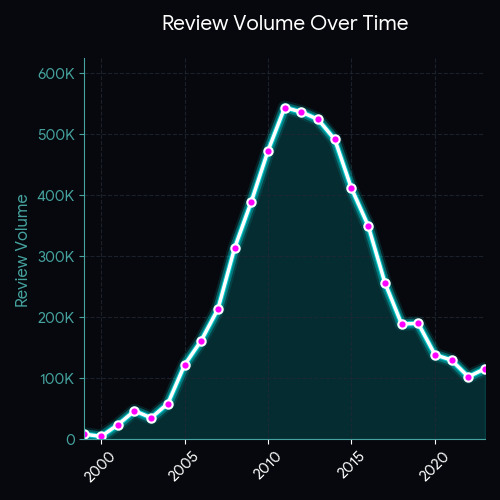
The model was trained and evaluated on a large-scale dataset containing 4.6 million ratings across 2.8 million users and 137K items, requiring careful handling of sparsity and generalization.
Video Presentation
Approach
- Implemented SVD-based latent factor decomposition
- Optimized user and item embeddings using stochastic gradient descent
- Applied L2 regularization to mitigate overfitting
- Tuned hyperparameters including embedding dimension, learning rate, and regularization strength
- Benchmarked against multiple baseline models:
- Global mean predictor
- User bias model
- Item bias model
- Pearson similarity
- Jaccard similarity
- Time-decay similarity variants
Results
The SVD latent factor model achieved:
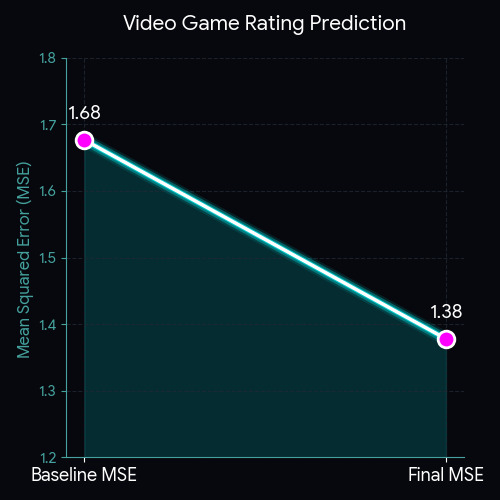
- Test MSE: 1.3779
- Global Mean Baseline MSE: 1.6768
- ~17–18% reduction in prediction error compared to baseline
Latent factor modeling consistently outperformed similarity-based and bias-only approaches on both validation and test sets.
Teamwork & Collaboration
This project was completed in a team of four engineers.
I led the team by organizing task distribution, setting internal milestones, and ensuring alignment with project deadlines. We followed lightweight Agile practices, including:
- Bi-weekly standup meetings to track progress and resolve blockers
- Iterative development with incremental model improvements
- Clear division of responsibilities (data preprocessing, modeling, evaluation, benchmarking)
- Shared Git-based workflow for collaboration and version control
I coordinated model experimentation efforts and aligned the team on evaluation methodology to ensure consistent and fair comparison across all models.
What I Learned
- Why matrix factorization scales better than memory-based similarity models
- The impact of regularization in high-sparsity datasets
- How hyperparameter tuning meaningfully affects generalization performance
- How to design reproducible evaluation pipelines for recommender systems
- How to lead a small engineering team using Agile principles to deliver a complete, well-evaluated system on schedule